TL;DR
A project or an initiative must have only one person ultimately responsible for it.
This is how I was first exposed to this: we were in a meeting with a group of investors who had just invested in MindMiners. The goal was to give them context on how the company operated on a day-to-day basis so they could better understand the business and, in turn, better help us.
When we were explaining about a project, an investor asked: but who is responsible for the decision to move forward?
We said: all of us (referring to the company’s leaders).
Then, she said: so, nobody is responsible.
We looked at each other without understanding what she meant and, as we usually did at that time, continued explaining how we worked with some excuse to move forward.
Later, she pulled us aside and said: guys, leaving responsibility to a group of people is the same as leaving it to no one. You need to choose only one person to be responsible for a project.
To be honest, I didn’t really care at the time about what she said. I thought it was a small thing… that our way of dealing with things, seeking some kind of consensus on everything was the right approach on project management.
With time, we started to realize and understand what she was referring about.
Many internal projects started to reach some sort of inertia, or remained frozen in time. Until finally, I came across this concept of diffusion of responsibility… and then things started to make some sense.
What is Diffusion of Responsibility
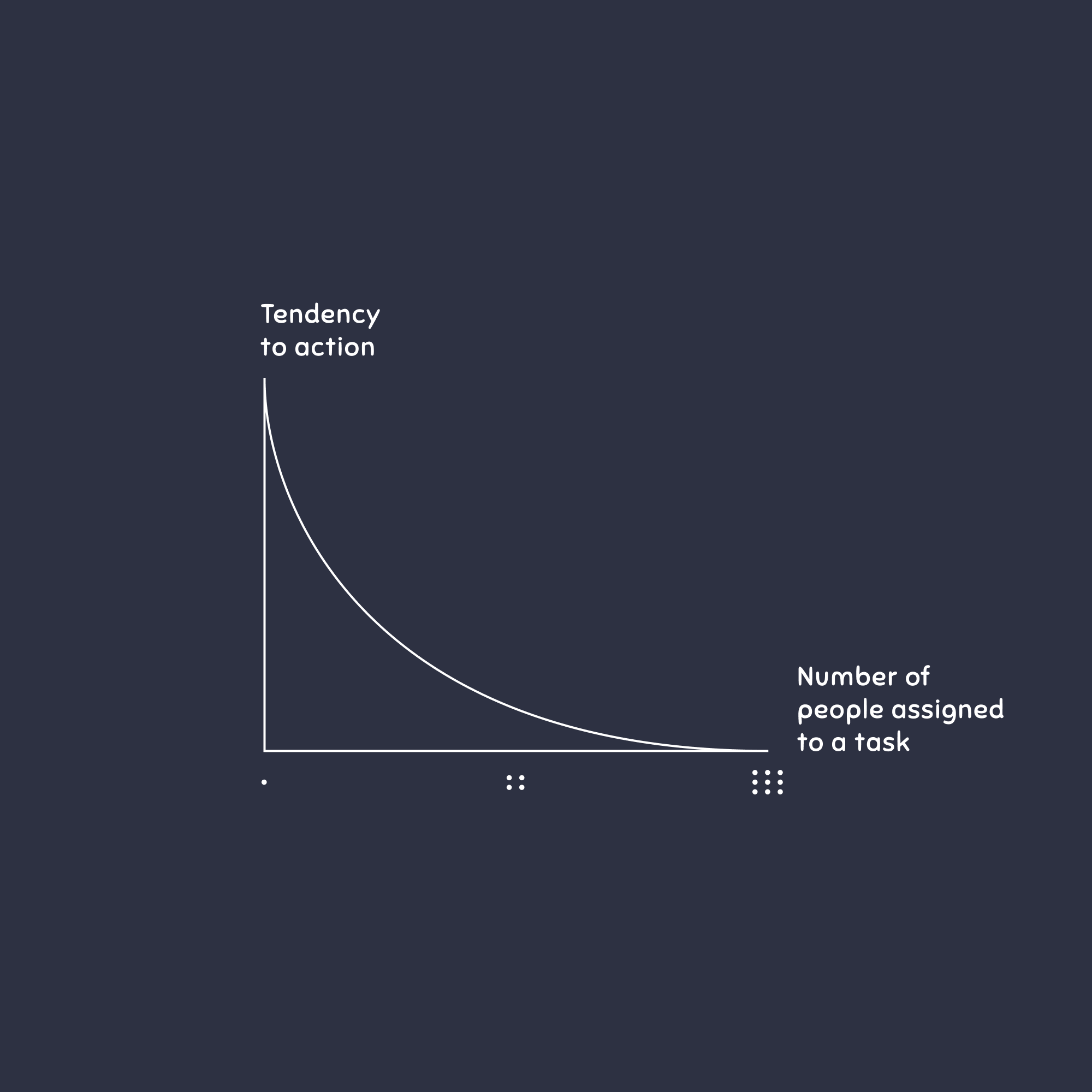
Diffusion of responsibility is a psychological phenomenon where individuals in a group setting are less likely to take action or make decisions because they assume others will.
It’s not merely about avoiding work; it’s just because there is a dilution of personal accountability when tasks or decisions are perceived to be shared among a collective.
The net result is often inaction, delay, or suboptimal outcomes because everyone assumes that “someone” will handle it.
I’m sure you have already faced some examples of it.
Where does this idea come from?
The Bystander Effect
The term “Diffusion of Responsibility” owes its origin to social psychologists John Darley and Bibb Latané. Their work in the 1960s about the bystander effect laid the foundation for understanding how responsibility gets diluted in group settings.
They started studying this idea after a tragic case of a young woman who was attacked and murdered in New York, in 1964. The reports at the time suggested that there were numerous witnesses that saw or heard the attack but did not intervene or call the police.
Darley and Latané conducted experiments to understand this behavior better. In a controlled setting, they found that individuals were less likely to help someone in distress if they believed other people were also aware of the situation.
Note that various factors can contribute to the bystander effect, including fear of embarrassment, not wanting to assume responsibility, and the assumption that someone else will take action.
Their conclusion was that the more bystanders there are, the less likely it is that any one of them will intervene, therefore leading to a diffusion of responsibility across the group.
Diffusion of Responsibility at Work
In the realm of business, particularly in things like project management in general, diffusion of responsibility manifests in various ways.
But, in general, when a project involves multiple departments, the lack of a single point of accountability can lead to delays, cost overruns, or even project failure. “Single point” means an individual, not an entire department.
Without a responsible individual, these are the main problems I’ve seen to emerge:
- Projects lack cadence of execution. When there is a clear owner for the ultimate result of the project, this owner will do what it takes to move the project forward. She will get inputs from all parties involved to understand work status and be sure that deadlines are followed. Why? Because in the end, if the project gets late, she will be accountable for, and nobody wants to be regarded as inefficient at work.
- Decision-making slows down. In the absence of a single responsible individual, decision-making often becomes a cumbersome process. Multiple parties may weigh in, leading to delays and potential conflicts. An owner would streamline this process by either making decisions or designating the appropriate person to do it.
- Resource allocation becomes inefficient. Without a single point of accountability, it’s challenging to prioritize resources effectively. Unless there is a facilitated way for information to flow between the involved teams, tasks may be duplicated, or sometimes be neglected, leading to wasted time and resources.
- Communication suffers. A diffusion of responsibility can lead to fragmented or inconsistent communication. A project owner would typically serve as a central hub for information, ensuring that all stakeholders are aligned and informed.
Here, we are not entering the discussion around individual incentives, which I believe play a major role as a driver for action and that can both mitigate or magnifies this effect. I’ll leave that for another post.
Key Action Points
Ok, so, what do I suggest to do in order to mitigate this phenomena:
- Clearly define roles: Assigning specific tasks and responsibilities to individuals rather than groups or multiple individuals helps in ensuring clarity and accountability. By clearly defining roles, everyone knows what is expected of them, which reduces confusion and increases efficiency within the team.
- Make it public: Making responsibilities and tasks accessible for others to see and know who is responsible creates social pressure, motivating individuals to complete their assigned tasks in a timely manner. This transparency fosters a sense of ownership and encourages teamwork.
- Regular Accountability Checks: Implementing regular review meetings to evaluate the status of responsibilities and tasks helps in maintaining accountability. These meetings provide an opportunity to identify any bottlenecks or challenges that individuals may face and address them promptly. They also allow for adjustments to be made and ensure that goals are being met effectively.
What did we actually do, in more practical terms:
On our team wiki, we created a page called Team Responsibilities. In this page, we created a table where all responsibilities per team were written down and, for each one of them, a Direct Responsible Individual (aka. Owner) had to be tagged, as well as a backup DRI.
The DRI had to describe what the responsibility was, in terms of details, data sources, important links, processes etc. so any new DRI could take along on the job if any substitution had to be made.
I can prepare and share a template of such table, so please let me know if this is something valuable for you clicking in the like button or sending me a message, so I know if there is enough people interested in this.
Well, I hope this helps you in your journey my friend. Feel free to share your thoughts with me on social platforms.